Key takeaways
You notice a dark patch on the ceiling, or water dripping through a light fitting, or a steady sound of something hitting the floor in the room above. That is the moment this guide is written for.
If your roof is leaking, the immediate priority is not getting someone on the roof. It is limiting the damage happening inside the building right now. Water that has been getting in for hours soaks through plasterboard, saturates insulation, tracks along joists, and can reach electrical wiring before you realise how far it has spread.
These six steps cover exactly what to do in the first hour, how to work out where the water is actually coming from, and when the job needs a professional rather than a temporary fix.
The immediate priority is to limit the spread of water inside the building, identify where it is coming from, and secure the affected area before attempting to access the roof. Starting repairs before the interior is secured and the damage is properly documented can lead to greater costs and complications later.
The following steps can help you contain the damage, identify the source, and prepare for a professional inspection.
Put buckets, bowls, or any large containers under every drip point you can find. Lay towels or plastic sheeting flat on the floor beneath the affected area.
Move anything electrical, including lamps, extension leads, and devices, away from where water is falling or pooling. Do not leave appliances running underneath an active leak.
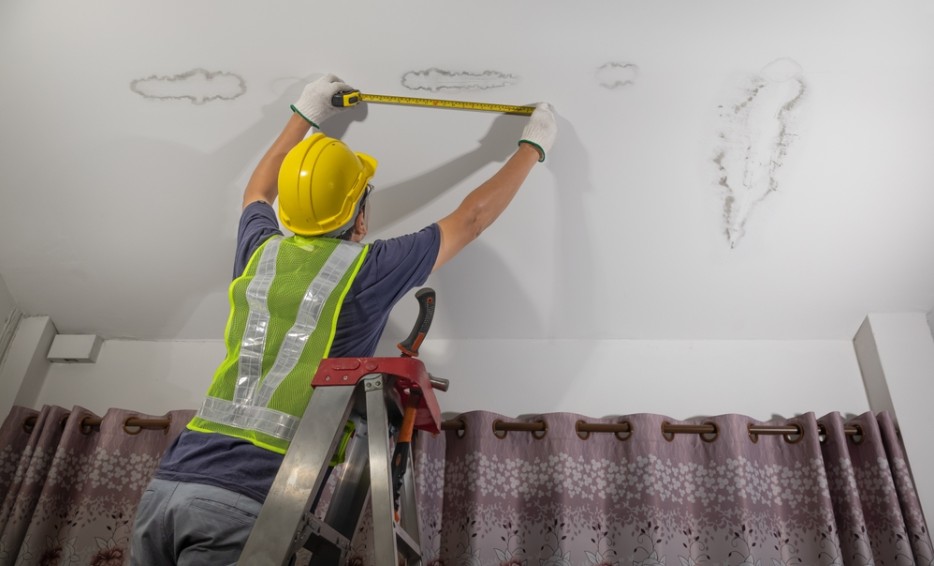
If the ceiling is bulging or sagging, that means water has already pooled above the plasterboard. Left alone, a saturated ceiling will come down under its own weight, usually unexpectedly and with significant force.
Take a screwdriver and carefully puncture the lowest point of the bulge to drain it in a controlled flow into a bucket underneath. It causes less damage than letting it collapse.
Before you investigate further, turn off the circuit breaker for any circuits running through the wet area. Water tracking along a joist can reach a ceiling rose or junction box well before any visible sign appears at the fitting itself.
Do not assume a fitting is safe because it looks dry. If a ceiling light, switch, or socket is anywhere near the leak, treat the circuit as compromised until a qualified electrician has inspected it. This is not an area where visible inspection is reliable enough.
For landlords and commercial property managers, this is also a compliance point. A water-affected electrical installation in a rented or commercial property has to be inspected and certified before it goes back into service.
The wet patch on your ceiling is almost never directly below where the roof is leaking. Water enters through a gap, runs along a rafter, joist, or sarking board, and drops through at whatever weak point it reaches.
If you have loft access, go up with a torch during or shortly after rainfall. Look for wet patches on the underside of the roof deck, water staining along timbers, or damp insulation. Follow the trail upward and outward.
In most cases, the entry point will be at a junction: around a chimney stack, a flashing, a skylight, a valley, or a soil vent pipe, rather than on an open run of tiles or felt.
Note the location as precisely as you can. When you call a roofer, being able to say "the water appears to be tracking along the left-hand rafter about two metres from the chimney breast" is far more useful than "somewhere above the front bedroom."
On a flat or low-pitched roof section that you can reach safely from a ladder with both feet on the rungs, a self-adhesive flashing tape or a heavy-duty tarpaulin weighted at the edges can reduce how much water gets in while you wait for a roofer.
If you cannot make a safe temporary repair externally, your only option is internal containment. Keep the buckets emptied, keep the area clear, and get a roofer out the same day if water is entering in significant volume.
Before you move anything, soak up anything, or start making good, take photographs. Document the internal wet patches, the state of the ceiling or wall, any visible damage in the loft, and anything you can see on the roof exterior safely from the ground.
Citizens Advice notes that most standard buildings insurance policies cover sudden damage from storms, but exclude damage from gradual wear and tear. Photographs taken at the moment of discovery are the clearest evidence of which category applies.
Call your insurer and report the leak before arranging repairs. Some policies require you to notify them before repair work begins.
A temporary fix limits the damage. A proper inspection tells you what caused the leak, how extensive the underlying damage is, and what a lasting repair requires.
Get a roofer on site as soon as possible, not just to repair the visible damage but to assess the condition of the surrounding area. Water that has been getting in for any length of time can saturate insulation, begin to rot timbers, and create conditions for mould growth that are not visible until the roof covering is lifted.
For anything beyond a minor repair, get at least two quotes and verify that the contractor carries adequate public liability insurance before work starts.
Understanding what causes most leaks helps you spot the early warning signs before water starts getting through.
Flashing failure
The metal sealing strip around chimney stacks, skylights, and parapet walls is the single most common cause of roof leaks in the UK. Flashing lifts, cracks, or loses its bond over time, particularly through the temperature cycles of a British winter.
Cracked, slipped, or missing tiles or slates
A single missing tile on a pitched roof creates a direct entry point for water, and it can go unnoticed from ground level for some time.
Flat roof membrane deterioration
Felt, GRP, and EPDM flat roof coverings have lifespans of roughly 10 to 25 years depending on the material. As they age, they crack, blister, or split. Flat roofs on extensions are one of the most common sources of leaks in UK homes.
Blocked gutters
Gutters clogged with leaves and debris cause water to overflow at the fascia line, where it works its way under the eaves and into the roof structure. This is a maintenance issue, but it causes significant damage if ignored. As part of wider planned property maintenance, gutter clearance is one of the simplest ways to prevent water ingress.
Chimney deterioration
The mortar pointing between chimney bricks, the flaunching around chimney pots, and the lead flashings at the base of the stack all deteriorate over time. An ageing chimney stack is one of the most reliable sources of persistent roof leaks in older UK properties.
Failed roof penetrations
Soil vent pipes and flue liners are sealed where they pass through the roof covering. Those seals crack and fail with age, and the gaps are often difficult to spot from ground level.
The wet patch on your ceiling is a symptom, not a location. Understanding the difference matters when you are describing the problem to a roofer, or trying to work out how serious it is.
Water enters the roof structure at a single point, then moves. It follows the nearest timber downward and outward, sometimes travelling three or four metres before it finds a weak point in the ceiling below and drips through. A leak that appears in the centre of a bedroom ceiling may have entered the roof at the chimney stack on the opposite side of the house.
This is also why the same leak can appear to move. If it shows up in a slightly different place after the next rainfall, the entry point has not changed. The water has simply taken a different path through the structure depending on where it hit the roof and how fast it was running.
A roofer who goes straight onto the roof without inspecting the loft first is working from the wrong end of the problem. The loft is where the water trail is visible. The roof surface is where the repair happens, but the loft is where the diagnosis starts.
A roof leak in a rented or commercial property carries additional obligations beyond the immediate repair.
Under Section 11 of the Landlord and Tenant Act 1985, landlords are required to keep the structure and exterior of a residential property in repair, including the roof. A leak that is reported by a tenant must be investigated and repaired within a reasonable timeframe. What counts as reasonable depends on the severity; a minor drip may allow a few weeks, but a leak affecting habitable rooms or electrical safety should be treated as urgent.
For commercial leases, responsibility depends on the lease terms. Most commercial leases make the tenant responsible for internal repairs and the landlord responsible for the structure, but the specifics vary and disputes over roof leaks are common.
For landlords and property managers running multi-site portfolios across London, a planned maintenance schedule that includes annual roof inspections and gutter clearance will catch most of the conditions that lead to leaks before they develop into emergency call-outs. Preventative inspection costs a fraction of emergency repairs and the secondary damage that follows water ingress.
If you manage commercial property in London or the South East and need a roofing assessment as part of a wider maintenance programme, get in touch with FS Group or call us on 0800 689 3497.

When your roof is leaking, the sequence matters: contain the water, check for electrical hazards, identify where it is entering, apply a temporary fix if it is safe to do so, document everything, and get a professional inspection as soon as possible.
Most roof leaks are repairable. The cost of the repair is almost always less than the secondary damage to ceilings, plasterwork, insulation, timbers, and contents that follows when water is left unchecked.
The longer a roof leak goes without a proper repair, the more expensive the eventual fix becomes.
What should I do if my roof is leaking?
Contain the water inside using buckets and towels, check for electrical hazards near the leak, access the loft if possible to identify where water is entering, apply a temporary seal if it is safe to do so, photograph the damage, and arrange a professional roofing inspection as soon as possible.
Can I temporarily fix a leaking roof myself?
On a flat or low-slope roof section that is safely accessible from a ladder, self-adhesive flashing tape or a weighted tarpaulin can provide temporary cover. On a pitched roof, do not attempt access without appropriate equipment. Falls from wet or sloped roofs are extremely dangerous.
What causes most roof leaks in UK homes?
Failed flashing around chimneys, skylights, or roof valleys; cracked, slipped, or missing tiles or slates; deteriorated flat roof membranes; blocked gutters causing overflow at the eaves; and failed seals around soil vent pipes and other penetrations.
How do I find where a roof leak is coming from?
The visible wet patch inside is rarely directly below the entry point. If you have loft access, inspect the underside of the roof during or after rainfall with a torch. Water staining on timbers or damp insulation will point you toward the source. Entry points are almost always at junctions or penetrations rather than on open tile surfaces.
Is a roof leak covered by home insurance?
Most standard buildings insurance policies cover sudden storm damage. The key distinction is between storm damage and deterioration caused by wear and tear or poor maintenance. Photograph the damage immediately after discovery and check your policy wording carefully before making a claim.
How much does a roof leak repair cost in the UK?
Minor repairs such as replacing a few tiles or resealing flashing typically cost £150 to £400. A flat roof membrane replacement on an extension can run from £1,500 to £4,000 or more depending on size and material. Significant timber damage or chimney work sits at the higher end. Always get at least two quotes.
When should I call an emergency roofer?
If water is entering in significant volume, a ceiling is sagging, electrical fittings are affected, or the property is commercial with operational consequences, treat it as urgent and call a roofer the same day.
Roof problem that cannot wait?
A leak spreads quickly once water is in. Call us and we will get a roofer out to assess it.
Roof repair in London or the South East?
FS Group repairs roofs, gutters and flashing across London, Essex, Kent and Hertfordshire. Call to book an inspection.




.png)
.png)





























.jpeg)




.jpeg)


.png)
.png)
.png)
.png)